
ISO 14001:2026 Environmental Management Systems
ISO 14001:2026 Environmental Management Systems
ISO 14001:2026 is the standard that assists organisations in developing an Environmental Management System (EMS). The focus of an EMS ISO 14001 is the protection of the environment, the prevention of pollution and negative effects on climate change through controlling organisations activities that may have an impact on the environment. This approach also prompts the organisation to adopt a lifecycle perspective on all activities which assists organisations in identifying its aspects and impacts, which are aligned to a risk methodology.
The aspect and impact assessment is measuring the effectiveness of current controls (inherent risk) and whether this is sufficient to meet legal or strategic requirements. If the aspect is significant, then the organisation will place its attention on treatment plans. These environmental plans and programmes are linked to effective tools, applications, and monitoring and measuring equipment. In addition, policies, processes, procedures, work instructions, and reports that assist in aligning to the organisation’s strategic environmental targets, goals, and objectives will be covered.
What is ISO 14001:2026?
The objective of an Environmental Management System is to prevent pollution and negative effects on climate change and strive to effectively protect the environmental workspace that can be affected by the organisations activities within the scope. The key requirement of the ISO 14001 standard is to comply with legal and other requirements including environmental legislations such as the National Environmental Management Act: Waste Act, Air Quality, and National Water Acts just to name a few. A Legal Evaluation is imperative for a successful Environmental Management System and prevention of serious consequences as a result of noncompliance to legislative requirements.
The intended outcomes of an ISO 14001 environmental management system include:
- Enhancement of environmental performance.
- Contribution toward the reduction of climate change.
- Fulfilment of compliance obligations and prevention of legal fines and penalties.
- Achievement of environmental objectives.
- Protecting the environment by preventing or mitigating environmental impacts.
- Mitigation of potential negative impacts on the environment the organisation.
- Being transparent to relevant interested parties by communicating environmental information
The clauses in the standard are based on a Plan-Do-Check-Act model which provides a process used within the organisation in order to drive and maintain continual improvement.
Below is the PDCA model which can assist new and existing employees in an organisation to understand the importance of a systems approach;
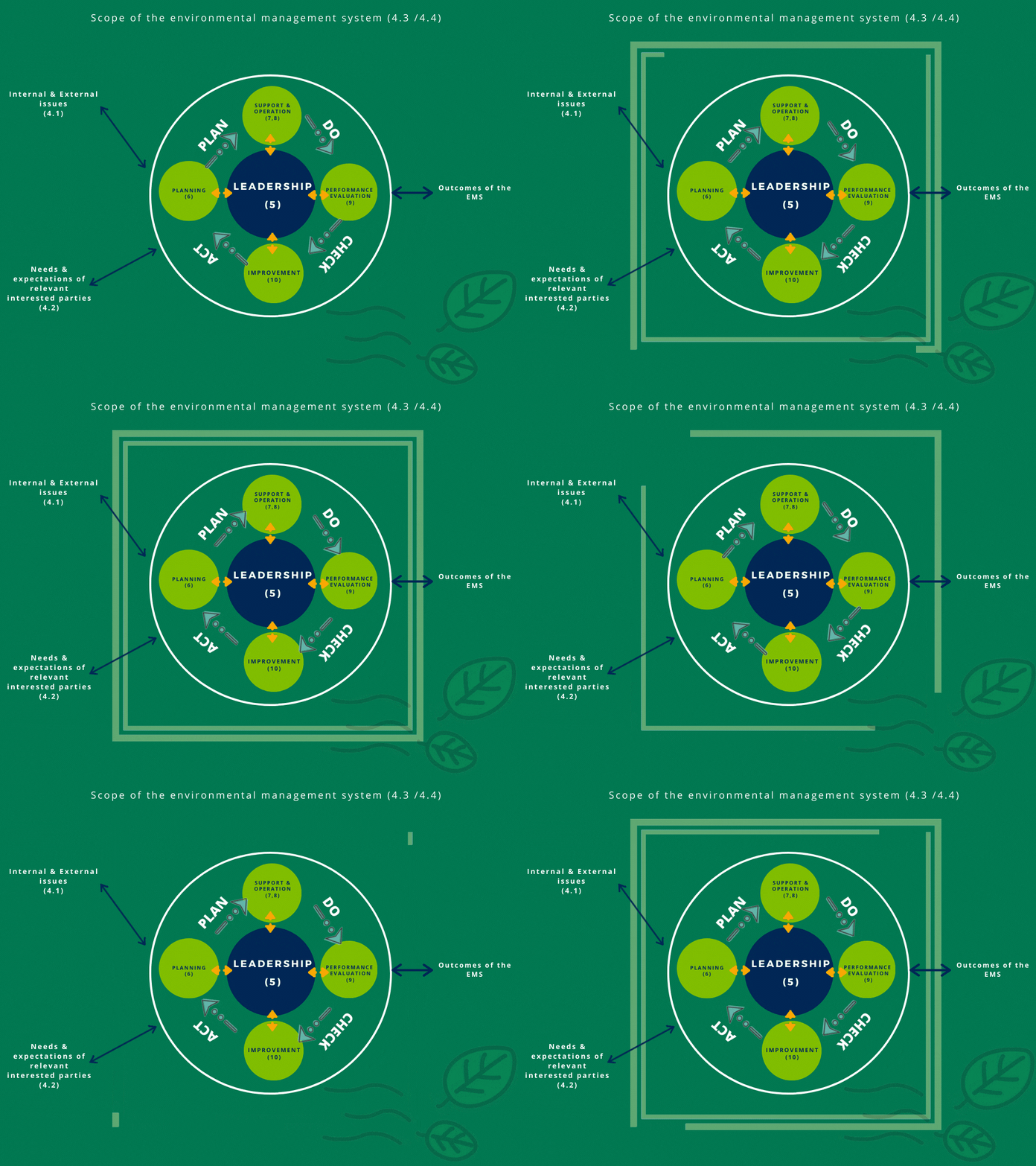
Below is a brief description of the PDCA cycle:
Plan – Determine and assess Environmental risks, Environmental opportunities and other risks and other opportunities, establish Environmental objectives and processes necessary to deliver results in accordance with the organisation’s Environmental policy.
Do – Implement the (Environmental) controls and processes as planned.
Check – Monitor and measure activities and processes with regard to the Environmental policy and Environmental objectives and report the results.
Act – based on the acquired results, take measures and activities to improve performance.
Risk-based thinking enables an organisation to identify factors that could have a negative impact on the Environmental Management System. An organisation is required to analyse and prioritise the risks, opportunities and environmental impacts based on what they think is acceptable and what is unacceptable to the organisations risk appetite. Preventive controls need to be in place to minimise any potential nonconformances and their recurrence.
Why does an Organisation need ISO 14001:2026?
ISO 14001 is suitable to any organisation, regardless of size or type of industry, whether private or government. Identification of the environmental aspects and impacts of the organisation’s activities, products, and services allows for a proactive approach which enhances the organisations resilience. ISO 14001 does not specify environmental performance criteria, as these are dependant on the type of activities conducted by the organisation and strategic direction and an EMS can be easily integrated with any existing ISO management system.
This standard was primarily developed to assist organisations with having effective processes in place, which may prevent many incidents from occurring. It can encourage better environmental performance of suppliers by integrating them into the organisation’s business systems.
Case studies have shown that standards served as the basis for innovating business processes, allowing companies to expand their suppliers’ network or to introduce and manage new product lines effectively.
What are the Benefits of Implementing ISO 14001:2026?
There are many reasons why an organisation should implement ISO 14001:2026. The standard is known to:
- Assist in demonstrating compliance with current and future statutory and regulatory requirements.
- Assist Top Management in engaging with employees.
- Improve company image, credibility, and the confidence of stakeholders through strategic communication and accurate environmental, social and governance reporting.
- Promote the use of evidence-based decision making through effective monitoring and measurement.
- Offer a competitive advantage against companies that do not adopt the standard.
- Reduce costs.
- Reduce the organisations contribution to climate change.
- Integrate the organisation’s business system with the suppliers to encourage better environmental performance.
- Increase a business’s access to new customers and business partners.
- Create a culture of continual improvement.
Another benefit of being certified is the alignment of your organisation to the Paris Agreement. This includes activities designed to reduce the impacts of climate change, through appropriate financial flows, a new technology framework and an enhanced capacity-building framework. It also assists in accurate ESG Reporting Environmental and Social Governance to relevant and interested parties.
How do I implement ISO 14001:2026 in an organisation?
ISO Consulting and Implementation:
We have a range of professional consultants, engineers, and registered auditors to assist in implementing and maintaining your ISO management system. Our industry expertise includes services, telecommunication, manufacturing, construction, engineering services, fast-moving consumer goods, mining, power generation, state-owned companies, and government-run organisations. Each of our consultants takes the time to truly understand the processes of your organisation, which will enable them to implement ISO requirements accordingly and effectively. Hiring a consultant and the time spent to implement your ISO management system will definitely pay off in the long run.
WWISE has a 4-Phase Approach:
- Phase 1: Gap Analysis Audit and Information Gathering
- Phase 2: ISO Documentation, Risk Assessment, and Process Mapping
- Phase 3: Implementation and Training
- Phase 4: Certification
At WWISE we provide a fully inclusive solution that includes full turnkey awareness training, classroom and online training, and mentorship. As a consulting firm, we do not provide certification services. However, we will guide you through the certification process and ensure that your business becomes certified.
Why Choose WWISE to Assist your Organisation:
Certification Process:
An organisation can get certified to a requirement standard. You can implement the standard and get certified by a third-party.
