
ESG: What Is Changing in 2026?
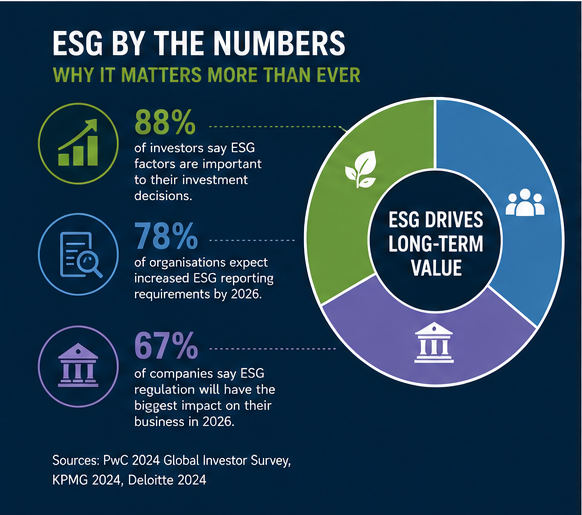
ESG is entering a more practical phase. Organisations are expected to show how environmental, social, and governance matters are identified, managed, measured, and reported.
Understanding the ESG meaning is becoming important for organisations of every size. ESG is no longer limited to sustainability reports or environmental commitments. It is increasingly connected to risk management, legal compliance, financial performance, and organisational governance.
This shift is being influenced by the Climate Change Act No.22 of 2024, King V, carbon tax developments, and the growing use of international sustainability reporting standards. Organisations must therefore establish the responsibilities, controls, and evidence needed to support credible ESG performance.
ESG meaning: What does ESG mean?
ESG stands for environmental, social, and governance.
In simple terms, the ESG meaning refers to how responsibly an organisation operates. It considers the effect the organisation has on the environment and people, as well as how its decisions, risks, and ethical responsibilities are governed.
ESG helps stakeholders understand more than an organisation’s financial results. It also provides insight into whether the organisation:
- Uses natural resources responsibly.
- Protects its workers and surrounding communities.
- Acts ethically and transparently.
- Manages environmental and social risks.
- Has effective leadership and internal controls.
- Can remain sustainable over the long term.
ESG is not one law, certificate, or reporting framework. It is a broad approach used to assess how environmental, social, and governance matters are included in organisational strategy and decision making.
What are the three types of ESG?
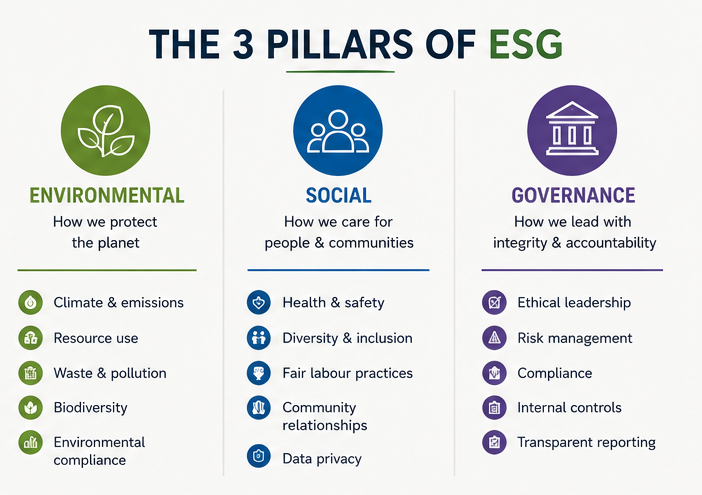
The three types of ESG are environmental, social, and governance. These areas are connected, and weakness in one area can create risks across the entire organisation.
For example, an environmental incident may affect employee safety, community relationships, legal compliance, financial performance, and the organisation’s reputation. Effective ESG management therefore requires an integrated approach.
Environmental
The environmental part of ESG considers how an organisation interacts with the natural environment.
This may include:
- Greenhouse gas emissions
- Energy consumption
- Water use
- Waste generation
- Pollution prevention
- Resource efficiency
- Climate related risks
- Biodiversity and land use
- Environmental legal compliance
An organisation may assess how its operations affect the environment and how environmental changes could affect its ability to operate.
For example, water shortages may interrupt production, extreme weather may damage infrastructure, and rising energy costs may affect operational expenses.
Social
The social part of ESG considers how an organisation affects employees, customers, suppliers and communities.
This may include:
- Occupational health and safety
- Employee wellbeing
- Fair labour practices
- Skills development
- Diversity and inclusion
- Human rights
- Customer protection
- Data privacy
- Community relationships
Social performance is not limited to charitable or community initiatives; it also includes the way people are treated throughout the organisation and its operations.
An organisation with strong social controls should be able to demonstrate how it protects workers, responds to complaints, , and manages risks that could affect people.
Governance
The governance part of ESG considers how the organisation is directed, controlled, and held accountable.
This may include:
- Ethical leadership
- Governing body oversight
- Risk management
- Anti bribery controls
- Conflicts of interest
- Legal and regulatory compliance
- Internal controls
- Responsible decision making
- Transparent reporting
- Executive accountability
Governance supports the environmental and social parts of ESG. Without clear responsibilities, oversight and reliable information, environmental and social commitments may not lead to measurable results.
Why ESG is changing in 2026
Several regulatory and governance developments are increasing the importance of ESG.
The Climate Change Act commenced on 17 March 2025. It establishes a national framework for responding to climate change and supporting the transition towards a climate resilient and lower carbon economy.
Not every provision of the Act creates an immediate obligation for every organisation. However, the Act signals a more structured approach to climate governance, mitigation planning, adaptation, and accountability.
South Africa also entered the second phase of its carbon tax framework on 1 January 2026. The headline carbon tax rate increased from R236 to R308 per tonne of carbon dioxide equivalent.
For organisations affected by carbon tax requirements, accurate emissions information is becoming increasingly important. Environmental data may influence tax exposure, operational planning, investment decisions, and future reduction initiatives.
These developments show that environmental performance is becoming more closely connected to financial and operational risk.
King V strengthens ESG governance
King V was released on 31 October 2025 and applies to financial years beginning on or after 1 January 2026. It replaced King IV and reflects changes in the governance environment.
The revised Code places continued emphasis on ethical leadership, responsible corporate citizenship, sustainable value creation, and transparent disclosure.
For governing bodies, ESG should not be treated as a separate initiative that belongs only to a sustainability department. Environmental and social matters may affect strategy, risk, performance, and the organisation’s ability to create value.
Governing bodies should therefore understand:
- which ESG matters are significant to the organisation;
- who is responsible for managing them;
- how performance is measured;
- whether reported information is reliable;
- how ESG risks affect organisational objectives; and
- whether policies and controls are operating effectively.
Meaningful governance requires more than approving an annual sustainability report; it requires regular oversight, informed decision-making, and evidence that responsibilities are being fulfilled.
ESG is moving from commitments to evidence
Organisations have often described ESG through policies, targets and public commitments. The current shift is towards evidence that shows what is actually being achieved.
A target may communicate the intended outcome, but stakeholders may also want to know:
- how the target was selected;
- which data was used;
- who is responsible for the target;
- how progress is calculated;
- which controls protect the accuracy of the information;
- whether limitations or missed targets are disclosed; and
- whether performance has been independently reviewed.
This requires ESG information to be managed in a structured way.
Spreadsheets, estimates, and information collected from different departments can create inconsistencies. Different teams may use different reporting periods, definitions, or calculation methods.
Organisations should establish documented methods for collecting, reviewing, approving, and retaining ESG information. Each important measure should have a clear owner and supporting evidence.
A practical ESG data example
An organisation reporting its electricity consumption should be able to identify:
- The sites included in the calculation.
- The reporting period.
- The source of the electricity information.
- The person responsible for collecting it.
- How missing information is treated.
- How the final figure is reviewed.
- Where supporting records are retained.
This process creates a reliable evidence trail. It also helps the organisation identify errors before information is included in a formal report.
How IFRS S1 and IFRS S2 shape ESG reporting
The International Sustainability Standards Board developed IFRS S1 and IFRS S2 to create a consistent global baseline for sustainability related financial disclosures.
IFRS S1 focuses on sustainability related risks and opportunities that could affect an organisation’s prospects. These may influence cash flows, access to finance, or the cost of capital over the short-, medium-, or long-term.
IFRS S2 focuses specifically on climate related risks and opportunities.
The standards organise disclosures around four connected areas:
- Governance
- Strategy
- Risk management
- Metrics and targets
South African regulators are considering how sustainability disclosure requirements could align with these standards. The Financial Sector Conduct Authority has indicated that planned requirements for larger listed entities are expected to begin with climate reporting.
This does not mean that every organisation is currently required to report under IFRS S1 and IFRS S2. However, the standards are influencing how investors, financial institutions, and other stakeholders assess sustainability information.
Organisations that prepare early can identify data weaknesses, responsibilities, and reporting limitations before formal requirements or stakeholder requests increase.
How management systems can support ESG
ESG programmes often struggle when they are managed separately from normal organisational processes.
Existing management systems can provide many of the controls needed to manage ESG risks and information.
For example:
- ISO 14001 can support environmental aspects, impacts, objectives, and environmental performance.
- ISO 45001 can support worker health, safety, consultation, and participation.
- ISO 37001 can support anti-bribery governance and ethical controls.
- ISO 9001 can support process control, responsibilities, and continual improvement.
- ISO 27001 can support information security, data protection, and access controls.
These standards do not replace an ESG framework or sustainability reporting requirements. However, they can provide structured processes, assigned responsibilities, internal audits, corrective actions, and documented evidence.
The strongest approach is to identify which controls already exist and determine where additional ESG specific processes are needed.
Practical steps organisations can take now
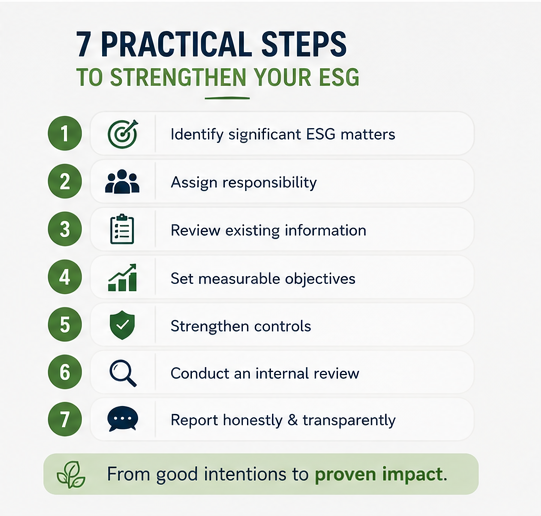
Organisations do not need to measure every possible ESG issue immediately. They should begin with the matters that are most relevant to their operations, stakeholders, legal duties, and strategic objectives.
1. Identify significant ESG matters
Consider the environmental, social, and governance issues that could affect the organisation or the people and environments affected by its activities. This may include emissions, water, worker safety, ethics, privacy, community concerns, or climate related disruption.
2. Assign responsibility
Each significant ESG matter should have an accountable owner. Responsibilities should cover data collection, operational performance, legal monitoring, management review, and reporting approval.
3. Review existing information
Determine which ESG information is already available and whether it is complete, consistent, and supported by evidence. Organisations should not assume that existing reports or spreadsheets are accurate without reviewing their sources and calculation methods.
4. Set measurable objectives
Objectives should be connected to a clear starting point, time-period, measurement method, and responsible person.
A broad commitment such as reducing environmental impact is difficult to evaluate. A defined target allows the organisation to measure progress and identify when corrective action is needed.
5. Strengthen controls
Document how ESG information is collected, checked, approved, and retained. Controls should reduce the risk of incorrect, incomplete, or inconsistent reporting.
6. Conduct an internal review
An internal audit or readiness assessment can test whether ESG controls are operating as intended. The review should compare reported information with source evidence and assess whether responsibilities are clearly understood.
7. Report honestly
ESG reporting should explain both progress and limitations. Organisations should avoid presenting estimates as confirmed results or excluding information simply because it reflects poor performance. Transparent reporting helps stakeholders understand the organisation’s actual position.
Common ESG management mistakes
One common mistake is treating ESG as a reporting exercise rather than an organisational responsibility. A report cannot compensate for weak controls, unclear ownership, or limited oversight.
Another mistake is collecting large amounts of data without first deciding why the information is relevant. This can increase administrative work without producing useful insight.
Organisations should also avoid setting targets without confirming whether reliable baseline information exists. Without a clear starting point, it becomes difficult to measure whether performance has improved.
A practical ESG approach should connect strategy, risk, operations, compliance, and reporting. The information presented externally should reflect what is happening within the organisation.
Preparing for the next stage of ESG
ESG is becoming more closely connected to governance, climate risk, financial information, and organisational accountability.
The Climate Change Act, King V, carbon tax developments, and international disclosure standards are increasing expectations for credible ESG information. Organisations should be able to explain what they measure, why it matters, who is responsible, and which evidence supports their claims.
Preparing does not begin with producing a lengthy ESG report. It begins with understanding the ESG meaning, identifying material issues, assigning accountability, and strengthening the systems used to manage performance.
WWISE assists organisations in establishing management systems, governance controls, and auditing processes that support measurable environmental, social , and governance performance.
